
I. Application Background
With fast start-up, reliable power supply and strong adaptability, diesel generator sets are widely deployed as standby or prime power sources in data centers, industrial plants, commercial complexes, communication base stations and overseas engineering projects. However, particulate matter (PM, i.e. black smoke) and nitrogen oxides (NOₓ) generated during diesel combustion are two primary pollutants from genset exhaust. As domestic emission regulations for non-road mobile machinery keep tightening and environmental requirements for generator sets in overseas markets continue to rise, engine-in-cylinder combustion optimization alone can hardly meet emission compliance. Exhaust aftertreatment systems are gradually becoming standard equipment for generator sets in the 150 kW power range.
To address this demand, Green Valley Environmental provides an integrated exhaust treatment solution combining DPF (Diesel Particulate Filter) and SCR (Selective Catalytic Reduction) for 150 kW generator sets, enabling simultaneous control of black smoke and NOₓ.
II. Treatment Requirement Analysis
150 kW gensets are generally used for standby power or distributed power supply. Their operating conditions carry distinct industry characteristics and impose corresponding requirements on the emission control system:
- Large load fluctuation: The genset frequently switches between start-up, idling and sudden load on/off, resulting in sharp variations in exhaust temperature and flow rate. The aftertreatment system must feature excellent condition adaptability.
- Severe black smoke issue: Incomplete combustion occurs under low-load and cold-start conditions, leading to obvious particulate emissions and visible black smoke, which directly affects the owner’s environmental acceptance and surrounding environment.
- Mandatory NOₓ control: NOₓ is a key assessment indicator under both domestic non-road emission regulations and emission clauses of overseas projects.
- Space constraint & integration: Installation space for the genset is limited. The treatment unit shall be compact, easy to connect with exhaust piping and bring no excessive maintenance burden.
In response to the above requirements, Green Valley Environmental adopts a series configuration: DPF upstream for particulate capture and SCR downstream for NOₓ removal, balancing treatment performance and operational reliability.
III. Solution Composition
The DPF+SCR integrated emission control solution by Green Valley Environmental for 150 kW gensets mainly consists of the following modules:
- DPF Particulate Capture Unit: Wall-flow metallic substrate structure. Exhaust gas is forced to pass through substrate walls so particulates are trapped on inner channel surfaces for efficient black smoke removal.
- SCR DeNOₓ Unit: Installed downstream of the DPF. Urea solution is atomized and injected to trigger catalytic reactions, reducing NOₓ into harmless nitrogen and water.
- Urea Dosing Control System: Precisely adjusts urea injection volume based on operating parameters such as exhaust temperature and flow, to guarantee high DeNOₓ efficiency while restraining ammonia slip.
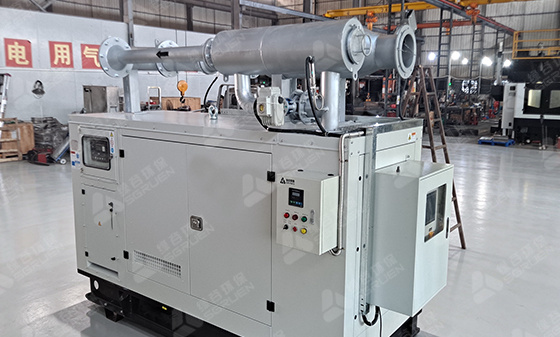
- Silencing & Integrated Structure: Emission treatment and silencing functions are integrated. Flange connection facilitates on-site installation. The compact overall layout fits the footprint of 150 kW generator sets.
IV. Advantages of DPF Particulate Capture
DPF serves as the core technology for black smoke abatement of diesel gensets. The DPF adopted in Green Valley Environmental’s solution features the following strengths:
- High filtration efficiency: The dry-type particulate filter delivers strong particulate capture capacity, drastically reducing black smoke and meeting the requirement of Ringelmann Smoke Chart Level 1.
- Regeneration capability: Targeting the pain point of particulate accumulation under low-load operation of standby gensets, the solution supports regeneration modes. Passive or active regeneration removes accumulated particulates inside the substrate to avoid backpressure build-up and genset power derating caused by filter clogging.
- Robust condition adaptability: The DPF maintains stable capture performance under frequent start-stop cycles and drastic load swings, and is resistant to failure from temperature fluctuations.
- User-friendly maintenance: The unit is designed for easy inspection and cleaning. Coupled with system condition monitoring, operation and maintenance staff can track filter status timely and reduce unplanned shutdowns.
V. Advantages of SCR DeNOₓ
The SCR unit undertakes deep NOₓ removal and acts as the core DeNOₓ component of the solution:
- High DeNOₓ efficiency: SCR is a mature DeNOₓ technical route for non-road sources. With proper temperature and catalyst, it achieves efficient NOₓ reduction to help gensets satisfy stringent NOₓ emission limits.
- Ammonia slip control: Green Valley Environmental adopts an accurate urea dosing strategy that dynamically adjusts injection volume according to exhaust temperature and real-time operating conditions. Excessive urea injection is minimized at the source to control ammonia slip and prevent secondary pollution and equipment corrosion.
- Stable operation: The system integrates monitoring of temperature, flow and other parameters. The dosing system responds rapidly and maintains matching between injection and catalytic reactions during sudden load changes, resulting in minor fluctuation of DeNOₓ performance.
- No interference with core genset functions: Pressure drop across the SCR unit is well controlled with limited impact on exhaust backpressure, ensuring reliable operation of the diesel engine.
VI. Synergistic Effect of the System
The series arrangement of DPF and SCR creates synergistic emission control benefits of “1+1>2”:
- Full coverage of pollutants: DPF focuses on particulate removal while SCR targets NOₓ. The combination covers the two core emission indicators of diesel gensets and realizes comprehensive improvement of exhaust performance.
- Clean operating environment for SCR: The upstream DPF intercepts particulates, lowering the risk of catalyst fouling and blockage. This helps preserve the activity and service life of the SCR catalyst and improves the long-term stability of the whole system.
Post time: Nov-27-2026